
The Data-Driven Decision Making (D3M) Lab is pleased to announce that undergraduate researcher Dhruv Raj Sanghavi earned First Place in the 2026 ICDS Symposium Research Poster Competition for his poster titled “Automated Multi-Class Segmentation of Zebrafish Micro-CT Scans Using a Deep Learning U-Net.”
The project focuses on applying deep learning techniques to automate the segmentation of anatomical structures within zebrafish micro-CT scans, an important task for biomedical imaging research. By leveraging a U-Net-based architecture, the research aims to improve the efficiency and accuracy of identifying and labeling biological structures, reducing the need for time-consuming manual annotation.
The project was conducted under the mentorship of Dr. Sayed Mohsin Reza (Penn State Harrisburg) in collaboration with Dr. Khai Chung Ang (Penn State College of Medicine). The research represents an interdisciplinary effort combining artificial intelligence, computer vision, and biomedical imaging to support future biological and medical research applications.
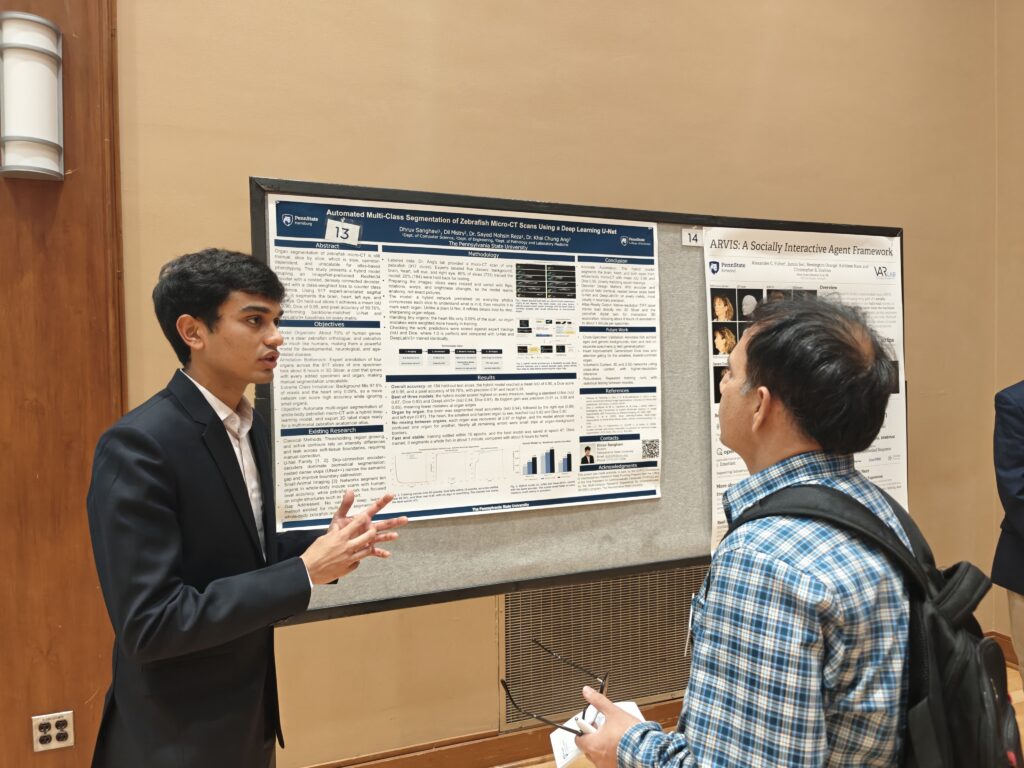
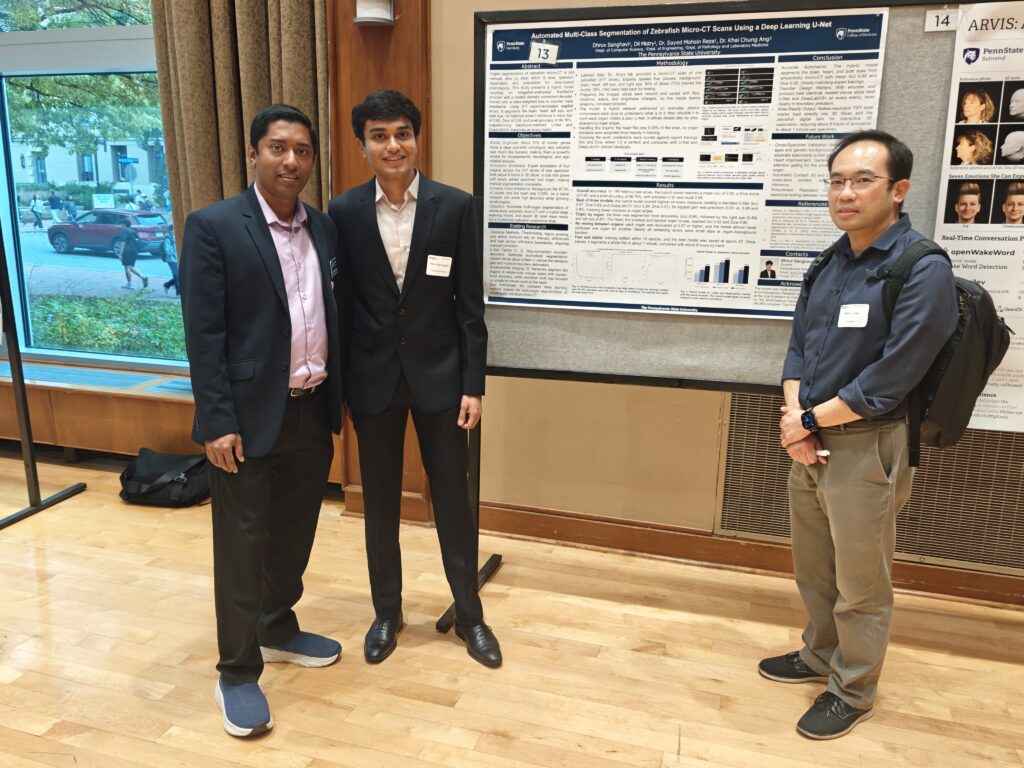
During the symposium, Dhruv presented the project to attendees, faculty members, and researchers from across Penn State. The poster generated significant interest and provided opportunities to discuss future directions, research collaborations, and potential applications of automated image segmentation in biomedical sciences.
The recognition culminated with the project being awarded First Place in the 2026 ICDS Symposium Research Poster Competition, accompanied by a $500 prize. The award recognizes the technical merit, presentation quality, and research impact of the project.
The D3M Lab congratulates Dhruv on this outstanding accomplishment and thanks all collaborators and mentors who contributed to the success of the project. This achievement highlights the growing impact of undergraduate research in artificial intelligence and biomedical imaging at Penn State.